Selecting the right Air Handling Unit (AHU) manufacturer is one of the most critical decisions a pharmaceutical facility can make. The AHU is the backbone of your cleanroom's HVAC system — it controls temperature, humidity, air pressure, and particulate contamination, all of which directly affect product quality, regulatory compliance, and patient safety. Choosing the wrong AHU manufacturer for pharmaceutical cleanroom facilities can mean costly retrofits, failed audits, or worse, contaminated batches. This guide walks you through exactly what to evaluate before you sign a purchase order, so you can select a manufacturer who meets GMP requirements, understands cleanroom classifications, and delivers long-term reliability.
Why AHU Selection Matters in Pharmaceutical Cleanrooms
Pharmaceutical manufacturing depends on tightly controlled environments. Airborne particles, microbial contamination, and pressure imbalances can compromise entire production batches, triggering regulatory action and financial loss. This is why AHU selection is never just an HVAC decision — it's a compliance decision.
Contamination Control and Product Safety
A well-designed AHU maintains unidirectional airflow, correct air change rates, and HEPA-grade filtration to keep airborne contaminants below the threshold required for your cleanroom class. Poorly designed systems allow particulate buildup, increasing the risk of product recalls.
Regulatory Risk if the AHU Isn't GMP or ISO 14644 Compliant
Regulatory bodies expect documented evidence that your AHU system was designed, installed, and validated according to Good Manufacturing Practices (GMP) and ISO 14644 cleanroom classification standards. Partnering with a GMP compliant AHU manufacturer in India (or wherever your facility is based) from day one avoids expensive redesigns during audits.
Key Factors to Evaluate Before Selecting an AHU Manufacturer
Not all AHU manufacturers are built for pharma-grade demands. Before shortlisting vendors, evaluate them against these five criteria:
GMP and ISO 14644 Compliance Certification
Ask for documented proof of compliance, not just verbal assurance. A credible manufacturer will readily share certification records and previous validation reports from pharma clients.
Material Quality
Cleanroom AHUs should use corrosion-resistant, non-shedding materials such as stainless steel (SS) or pre-coated galvanized iron (GI) panels. These materials resist microbial growth and are easier to clean and sanitize — both essential for maintaining cleanroom integrity over years of operation.
Customization Capability
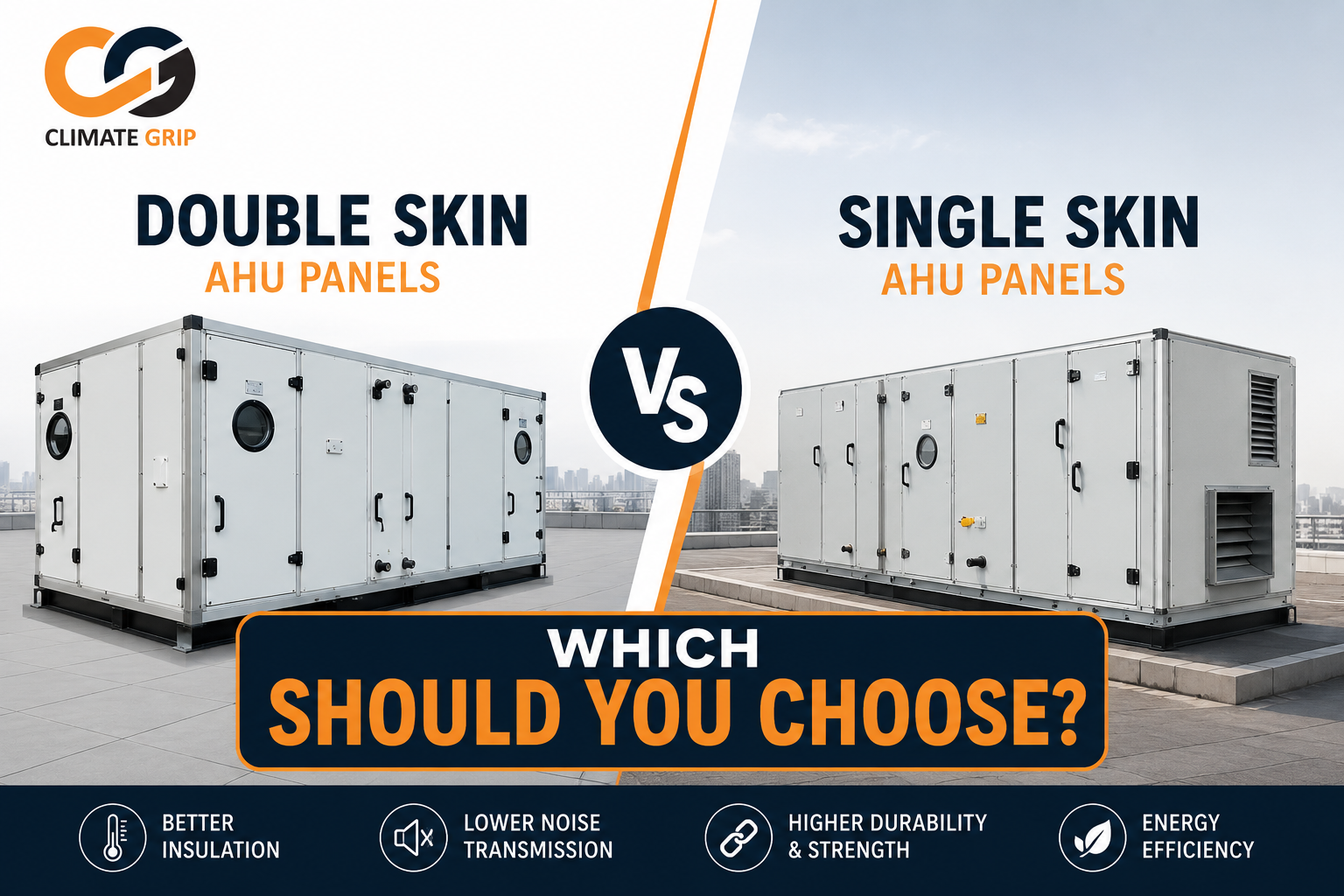
Every cleanroom has different airflow, pressure, and space requirements. A manufacturer offering both double-skin and single-skin AHU panel configurations, along with custom sizing, gives you flexibility to match the exact specification of your facility rather than forcing a one-size-fits-all unit.
Filtration Standards
Confirm that the manufacturer can integrate HEPA filters rated to match your required cleanroom class (ISO 5, 7, or 8, for example). Filtration mismatches are one of the most common reasons cleanrooms fail particulate audits.
Energy Efficiency Features
Pharma facilities typically run AHUs 24/7, so energy efficiency has a direct impact on operating cost. Look for manufacturers offering Variable Frequency Drives (VFDs), EC fans, and heat recovery wheels to reduce long-term energy consumption without compromising cleanroom performance.
How to Select an AHU Manufacturer for the Pharma Industry — Step by Step
Once you've identified a shortlist, use this step-by-step process to make your final decision:
1. Verify certifications and past pharma projects — ask for references from similar facilities, not just brochures.
2. Request validation documentation — confirm the manufacturer can support DQ, IQ, OQ, and PQ documentation required for regulatory audits.
3. Check after-sales service and AMC support — a manufacturer without a reliable Annual Maintenance Contract (AMC) program leaves you exposed to downtime.
4. Compare quotes on total cost of ownership, not just upfront price — factor in energy consumption, maintenance frequency, and expected system lifespan.
Best AHU Suppliers for Cleanroom Pharma Facilities — What Sets Them Apart
Not every supplier manufactures what they sell. Understanding this distinction can save you from support headaches later.
In-House Manufacturing vs. Outsourced Assembly
Manufacturers who fabricate AHU components in-house have tighter quality control and can customize designs faster than those who outsource assembly to third parties. Ask directly whether panels, filters, and controls are manufactured in-house or sourced from multiple vendors.
Turnkey vs. Component-Only Suppliers
Some suppliers only provide the AHU unit itself, leaving installation, ducting, and validation to separate contractors. A turnkey supplier who handles design, manufacturing, installation, and validation support under one roof reduces coordination overhead and accountability gaps.
Choosing a Pharmaceutical AHU Manufacturer in India
India has become a major hub for pharmaceutical manufacturing, and local AHU manufacturers offer distinct advantages for facilities operating in this market.
Advantages of Local Manufacturing
Working with a pharmaceutical AHU manufacturer based in India typically means shorter lead times, faster spare parts availability, and on-site technical support without the delays and costs associated with importing units from overseas.
What to Check in a Local Vendor's Compliance Track Record
Local doesn't mean lower standard — verify that the manufacturer's systems have passed audits at other pharmaceutical facilities in India and that their documentation aligns with both domestic (Schedule M) and international (ISO 14644) requirements. Climate Grip, for instance, has supplied AHU systems for pharmaceutical, hospital, and industrial cleanroom applications with a focus on GMP-aligned design and after-sales support — the kind of track record worth asking any manufacturer to demonstrate.
Common Mistakes to Avoid When Choosing an AHU Manufacturer
• Choosing on price alone — the cheapest quote often excludes validation support, spare parts, or energy-efficient components that cost more later.
• Ignoring validation support — a manufacturer unable to assist with DQ/IQ/OQ/PQ documentation will slow down your regulatory approval timeline.
• Overlooking long-term energy costs — a lower upfront price can be offset many times over by higher electricity consumption across a 24/7 operating cycle.
Conclusion
Choosing the right AHU manufacturer for pharmaceutical cleanroom facilities isn't a decision to rush. It requires verifying compliance credentials, assessing material and filtration quality, and confirming that the manufacturer can support you well beyond installation day — through validation, maintenance, and long-term energy performance. If you're currently evaluating AHU manufacturers for a pharma, hospital, or industrial cleanroom project, Climate Grip's team can walk you through a system designed specifically around your facility's classification and compliance needs. Reach out for a consultation and quote tailored to your project.
FAQs
What is the most important factor when choosing an AHU manufacturer for a pharma cleanroom?
Compliance credentials come first. A manufacturer must demonstrate GMP alignment and ISO 14644 cleanroom classification experience before any other factor — such as price or lead time — should be considered.
Is GMP certification mandatory for pharmaceutical AHU manufacturers?
While GMP certification of the manufacturer itself isn't always a legal mandate, the AHU system they supply must support your facility's ability to meet GMP requirements during audits. Working with a manufacturer experienced in GMP-aligned design significantly reduces audit risk.
What's the difference between single skin and double skin AHU panels for cleanrooms?
Single skin panels are lighter and more cost-effective but offer less thermal insulation and structural rigidity. Double skin panels have an insulated core between two metal layers, providing better thermal performance, reduced condensation risk, and improved durability — making them the preferred choice for most pharmaceutical cleanroom applications.
How much does a pharmaceutical-grade AHU system typically cost in India?
Costs vary widely based on airflow capacity, filtration class, customization, and material selection. Rather than comparing sticker price alone, request itemized quotes that separate the unit cost from installation, validation support, and AMC pricing so you can compare total cost of ownership accurately.
How do I verify an AHU manufacturer's validation documentation support?
Ask directly whether the manufacturer provides Design Qualification (DQ), Installation Qualification (IQ), Operational Qualification (OQ), and Performance Qualification (PQ) documentation, and request a sample validation package from a previous pharma project before signing a contract.